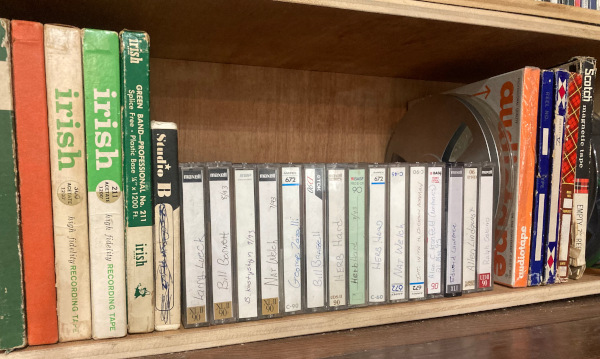
I have consistently sought out opportunities to make my academic research accessible to the public. That effort has included many opportunities to serve as a content matter expert on the history of sound recording technology. I have been quoted in publications such as Scientific American, the New York Times, the Chicago Tribune, the Baltimore Sun, the New York Post, Forbes (December 1999), Liberation (Paris), Wall Street Journal, ABCnews.com, Rutgers Focus, etc. My research contributed to a documentary for National Inventor’s Hall of Fame inductee Dr. Semi Joseph Begun, and was featured on the series Lost and Found Sound on National Public Radio. Most recently, I was interviewed for a segment for the PBS series, “The History Detectives” (Season 3, ep. 6). Most recently, I was interviewed for a Sirius Radio program on the revival of interest in the early-2000s recording format called the “Minidisc.”
I received permission to evaluate the Cochran Mill site near Palmetto, Georgia, which was then owned by Fulton County. In addition to updating and improving an earlier site evaluation, I published my findings in the journal Early Georgia. This project received financial support from the Georgia Tech Graduate Student Government. The article was published as The Engineer and the Millwright: Traditional and Modern Technologies at Cochran’s Mill Park, Fulton County, Georgia,” Early Georgia (December 1993).
I was an early contributor to author Bruce Sterling’s Dead Media Project.
Designed and taught the first undergraduate public history survey course for Georgia Tech’s program in History, Technology, and Society, 2005 (syllabus linked below)
Conference Chair, proceedings editor for ISTAS ’99: Women and Technology: Historical, Societal, and Professional Perspectives, sponsored by the IEEE Society on the Social Implications of Technology (SSIT), IEEE Women in Engineering, and Rutgers University
Reviewer for Technology and Society Magazine, published by IEEE SSIT
Guest Editor for IEEE Technology and Society Magazine, Special Issue on Women and Technology, Spring 2000
Volunteer Board of Governors member, secretary, Atlanta Chapter, etc. for the IEEE SSIT, acting as general advocate for awareness of the history of technology, 1999-present
The IEEE Virtual Museum – A major effort to launch an online museum of technology, aimed at experts, a general audience, and young people. In operation from 2001-2008, now superseded by the Engineering Technology History Wiki
Contract site designer and coder for the Society for the History of Technology, 2005 (thumbnail image above)
Managed the H-Southern Industry discussion board on H-Net.org, 2002-2005 (thumbnail image above)
Travelling and in-house exhibits for the IEEE, including two 50th Anniversary exhibits, for the IEEE Broadcast Technology and Electron Devices societies. My contributions included overall planning and management of the project, obtaining loaned artifacts from private individuals, curating text and photos, and managing the work of contracted designers.
Contributed web-based history content for a World War II exhibit at the Atlanta History Center, including short animated features and an interactive game programmed in Flash.
“The Web and Public History,” presented before the Georgia Association of Historians, Americus, Georgia, April 2003
What the Old Media Can Teach us About the New Media,” presented at the New Media Institute, University of Georgia, November 2003.
“Creating Online Exhibitions,” day-long seminar presented to the faculty and students of Middle Tennessee State University, 2003.
“Doing History on the Web,” presented before the Graduate Program in History, William Paterson University, 2001
“Virtual Museums and the Historian,” presented at Lehigh University, November 2001.
Session organizer and moderator for “Outside Engineering: Opportunities and Challenges for the Teaching of the Humanities and Social Sciences to Engineering Students,” at the International Symposium on Technology and Society 2001, Stamford, Conn.
“Sound Recording and the Information Age,” talk presented at the National Archives, Washington D.C., October 2000
“100 Years of Magnetic Recording,” a panel and musical concert organized by the National Academy of Sciences, Washington D.C., November 1998
“Hazeltine: A Fifty Year Anniversary,” talk presented for the Engineering School of the Stevens Institute of Technology, 1998
“Engineering Education in America,” talk presented for Rutgers University’s Pride In Engineering Day, 1997
(With Matthew Hild) Georgia Tech: A History(Arcadia, 2017)
(With Joseph Gabriel) Electronics: Life: Story of an Invention. Greenwood Press, 2005 and Johns Hopkins Univ. Press, 2007.
Sound Recording: Life Story of an Invention. Greenwood Press, 2004 and Johns Hopkins Univ. Press, 2006.
Off the Record: The Technology and Culture of Sound Recording in America. Rutgers University Press, 2000. [Note: this book has been well-received by both academic and popular readers]
Articles (public history-oriented only)
“Liberty Enlightening the World: The Electrical History of the Statue of Liberty,” Today’s Engineer, Nov. 2002. (also at http://www.todaysengineer.org/Nov02/heritage.htm)
“Benjamin Franklin’s Electric Motor,” Today’s Engineer, Aug-Sept. 2002. (also at http://www.todaysengineer.org/Aug02/heritage.htm)
“Guillaume Duchenne; Pioneer of Electrotherapy and Neuropathology,” Today’s Engineer, September 2002. (also at http://www.todaysengineer.org/Sept02/heritage.htm)
“In His Own Words: John R. Pierce,” Proceedings of the IEEE, August 2002.
“Electronic Mail,” “Office Technology,” and “Fax Machine,” in The Dictionary of American History (Gale Publications, 2002).
“The Memory of John Logie Baird,” Today’s Engineer, May-June 2002.
“The Industrial Revolution in Tattooing,” American Heritage of Invention and Technology Magazine, January 2002.
“This Week in Electrical History,” in The Institute (IEEE publication), a monthly column, all monthly installments from 2001-2002.
“Electric Rock and Roll,” Today’s Engineer, Oct.-Nov. 2001.
“Jack Morton of Bell Labs,” Today’s Engineer, Sept.-Oct. 2001.
“Tattoos: Electrical Engineers Played a Role in Giving Them — And Even Taking Them Away,” Today’s Engineer, July-Aug. 2001.
“Computers in Everything: From the Pushbutton Factory to the Y2K Bug,” Proceedings of the IEEE 87 (December 1999).
“Viewing Television’s History,” Proceedings of the IEEE 87 (July 1999).
“What Difference Did Semiconductors and Microelectronics Make?” Proceedings of the IEEE 87 (June 1999)
“Consumer Electronics: the Last Fifteen Years,” IEEE Circuits and Devices Magazine 15 3 (May 1999): 28-30.
“Radio Broadcasting in the Electrical Century,” Proceedings of the IEEE 87 (May 1999).
“A Snapshot of Telephony at the Turn of the Century,” Proceedings of the IEEE 87 (April 1999).
“Powering the Electrical Century,” Proceedings of the IEEE 87 (March 1999).
“Richard Howland Ranger, 1889-1962,” The Institute February 1999.
“A Salute To Jim Brittain,” Proceedings of the IEEE 87 (January 1999): 205 -205.
“Edwin H. Armstrong and the History of FM Radio: A Contextual Approach,” Proceedings of the Radio Club of America, November 1990.